
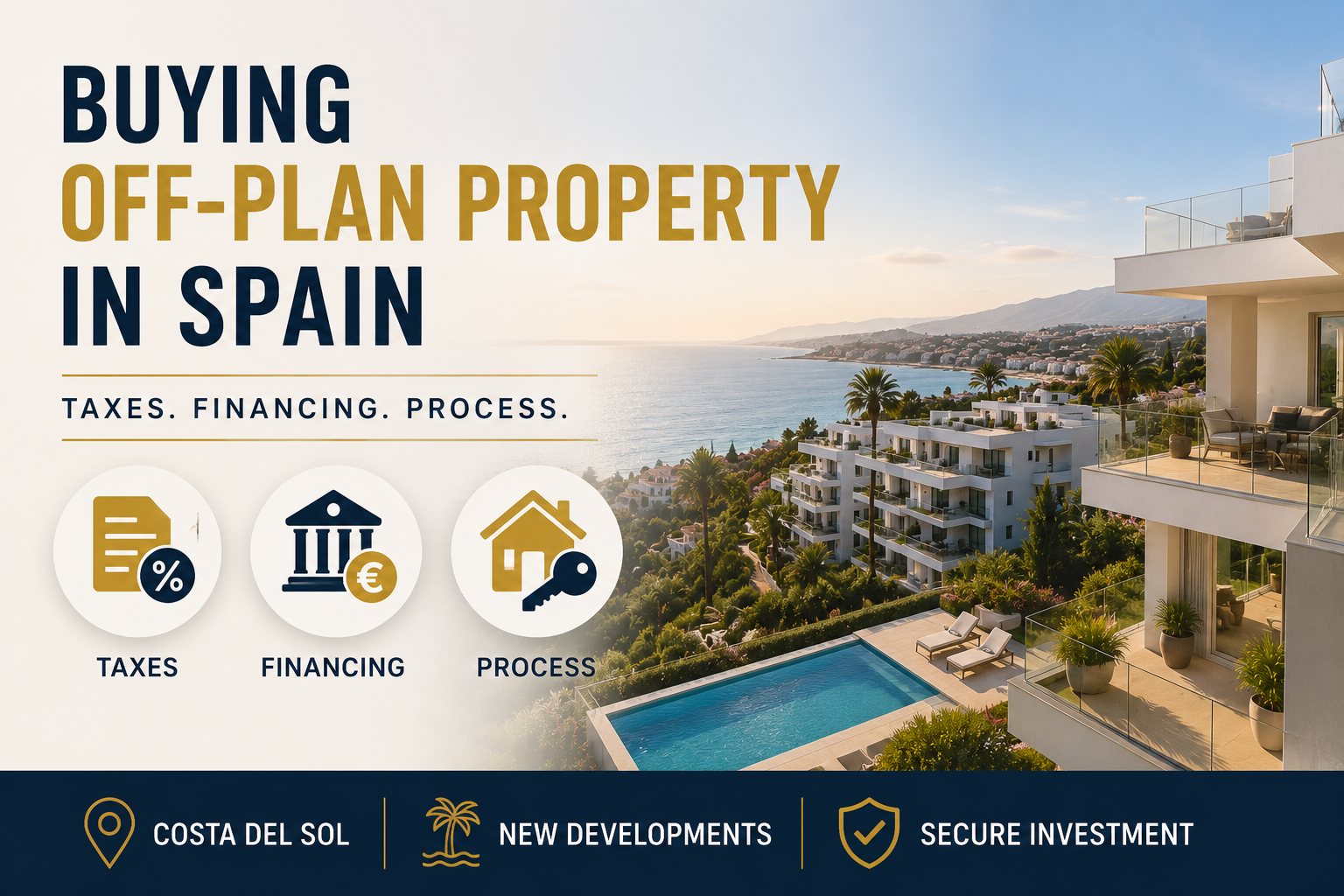
Buying an off-plan property on the Costa del Sol is financially very different from purchasing a resale home.
Instead of paying the full purchase price at the notary, buyers normally make a reservation payment followed by several staged payments during construction. The final balance is paid when the development is completed and the property is transferred to the buyer.
The taxes are different too.
Buyers of new properties purchased directly from a developer generally do not pay Property Transfer Tax (ITP). Instead, the purchase is normally subject to Value Added Tax (IVA) and Stamp Duty (AJD).
Financing can also be more complicated.
Spanish banks generally provide the buyer’s mortgage when the property has been completed and can be legally transferred. This means international buyers need to carefully plan how they will finance reservation payments and construction-stage instalments before receiving the keys.
Having followed numerous new developments and property transactions on the Costa del Sol, one of the most common mistakes I see is buyers focusing entirely on the advertised property price.
With off-plan property, understanding the payment schedule, taxes, bank guarantees and final financing requirements is just as important as choosing the apartment or villa itself.
What Is an Off-Plan Property in Spain?
An off-plan property is a home purchased before construction has been completed.
Depending on the project, the buyer may purchase:
- Before construction begins
- During the early construction stages
- When the structure is already visible
- Shortly before completion
The term can apply to apartments, penthouses, townhouses and villas.
New developments are particularly common across the Costa del Sol in areas such as Marbella, Estepona, Mijas, Benalmádena, Fuengirola, Casares and Manilva.
One major difference between buying off-plan and purchasing a resale property is how and when the money is paid.
How Does the Off-Plan Property Payment Process Work?
Every development can have a different payment schedule.
However, a typical off-plan purchase may involve several stages.
1. Reservation Payment
The process normally begins with a reservation agreement.
The buyer pays a reservation deposit to remove the selected property from the market for an agreed period.
The amount varies depending on the development.
Before paying, buyers should understand:
- Whether the reservation payment is refundable
- Under what conditions it can be returned
- The deadline for signing the private purchase contract
- What happens if legal due diligence identifies a problem
Independent legal advice is strongly recommended before committing substantial funds.
2. Private Purchase Contract
After the reservation stage and legal checks, the buyer normally signs a private purchase contract.
At this point, a larger percentage of the purchase price may become payable.
The contract should clearly establish:
- The property being purchased
- The agreed price
- Payment schedule
- Estimated completion date
- Property specifications
- Rights and obligations of both parties
- Guarantees protecting advance payments
- Consequences of contractual breaches
This is an important stage of the transaction.
Buyers should not rely only on marketing brochures, conversations with sales representatives or computer-generated images.
The contract and supporting legal documentation determine the buyer’s actual rights and obligations.
3. Construction-Stage Payments
Depending on the developer, additional payments may be required during construction.
For example, a development could require:
- A reservation deposit
- A percentage when signing the private purchase contract
- Another percentage during construction
- The remaining balance at completion
The exact structure varies considerably between projects.
This is why buyers should request a complete payment schedule before reserving an off-plan property.
When Do You Pay VAT on a New Build Property in Spain?
New residential properties purchased directly from a developer are generally subject to VAT, known in Spain as IVA.
The general VAT rate applicable to new residential property purchases is 10%.
This is one of the most important financial differences between new-build and resale property.
When purchasing a resale property in Andalucía, the buyer generally pays ITP.
When purchasing a qualifying new residential property directly from the developer, the buyer generally pays IVA instead.
For example, consider a new apartment costing €400,000.
At a 10% VAT rate:
Property price: €400,000
IVA: €40,000
The buyer therefore needs to consider at least €440,000 before accounting for AJD and other purchasing expenses.
Another important point is that VAT may become payable as payments are made to the developer.
Therefore, buyers should not assume that the entire tax bill will only become due when they receive the keys.
The timing of payments and applicable taxes should be confirmed for the specific transaction.
Do You Pay ITP When Buying an Off-Plan Property?
Generally, buyers do not pay ITP when purchasing a new residential property directly from a developer where the transaction is subject to IVA.
This distinction is important.
The basic difference is:
Resale property → ITP
New property purchased from a developer → IVA + AJD
However, individual transactions can have different legal and tax circumstances.
Buyers should obtain professional advice based on the specific property and purchase structure.
What Is AJD on a New Build Property?
In addition to IVA, buyers of new-build properties generally need to consider Stamp Duty, known as Actos Jurídicos Documentados (AJD).
AJD is a regional tax.
The applicable rate depends on the autonomous community where the property is located.
The Costa del Sol is in Andalucía, so buyers should calculate the applicable Andalusian AJD rate when preparing their purchasing budget.
This means the tax structure of a typical new-build purchase is not simply the advertised price plus 10% IVA.
AJD and other purchasing expenses must also be considered.
What Other Costs Should Buyers Budget For?
In addition to IVA and AJD, buyers may need to consider:
- Independent lawyer‘s fees
- Notary expenses
- Land Registry expenses
- Mortgage-related costs where applicable
- Property valuation
- Banking and international transfer costs
- Currency exchange costs
For international buyers, currency fluctuations can also significantly affect the final purchase cost.
A buyer earning or holding savings in British pounds, Swedish kronor, Norwegian kroner, Swiss francs or US dollars may see the euro cost of the property change during a two-year construction period.
Currency planning can therefore be an important part of buying off-plan in Spain.
Can You Get a Mortgage for an Off-Plan Property in Spain?
Yes, but buyers need to understand when the mortgage funds normally become available.
A Spanish bank generally does not provide a standard residential mortgage to finance a property that has not yet been completed and legally transferred to the buyer.
The final mortgage process normally takes place closer to completion.
This creates an important financial consideration.
Imagine purchasing an apartment under the following payment structure:
- Reservation payment
- 30% during the construction period
- 70% at completion
If the buyer expects a Spanish bank to finance part of the purchase, the buyer may still need sufficient personal funds to cover the reservation, construction-stage payments, applicable taxes and expenses before the final mortgage funds become available.
This is why financial planning should take place before reserving the property.
Can International Buyers Arrange Financing Before Completion?
Some international buyers have access to other financing options.
For example, buyers from Sweden, Norway, Switzerland and other countries may be able to use:
- Existing property equity
- Investment portfolios
- Private banking relationships
- Loans secured against assets in their home country
- International banking facilities
In some cases, buyers have arranged financing through international banks before the Spanish property was completed.
However, this should not be confused with a standard Spanish mortgage secured against the unfinished property.
The availability, conditions and cost of international financing depend entirely on the buyer’s financial circumstances, country of residence, assets and banking relationships.
Buyers should therefore investigate financing options before committing to a construction payment schedule.
When Should You Apply for the Spanish Mortgage?
Although the final mortgage normally relates to the completed property, buyers should not wait until the last moment to investigate financing.
Before purchasing, it is sensible to discuss:
- Expected loan-to-value
- Income requirements
- Age restrictions
- Loan duration
- Interest rates
- Required documentation
- Residency status
- Existing debts
International buyers should also remember that mortgage conditions for Spanish residents and non-residents can differ.
A buyer who assumes that the bank will finance a certain percentage of the purchase price may face a significant funding gap if the final mortgage offer is lower than expected.
What Happens If the Bank Valuation Is Lower Than the Purchase Price?
This is another financial risk that buyers should understand.
The bank’s mortgage offer can depend on the property’s valuation and the bank’s lending criteria.
If the bank valuation is lower than the agreed purchase price, the buyer may need to contribute more personal funds.
For example:
A buyer agrees to purchase a property for €500,000.
The buyer expects 70% financing.
However, the final bank valuation or lending decision results in a smaller mortgage than expected.
The buyer must then cover the difference using additional personal funds or alternative financing.
With an off-plan purchase, this can be particularly important because the buyer may have committed to the property months or years before completion.
Why Bank Guarantees Matter When Buying Off-Plan
One of the most important protections for off-plan buyers in Spain concerns advance payments.
Money paid during construction should receive the appropriate legal protection.
Depending on the transaction, advance payments may be protected through individual bank guarantees or insurance arrangements in accordance with applicable Spanish law.
The purpose is to protect buyers if the developer fails to complete the property under circumstances covered by the applicable legal framework and contract.
Buyers should ask their independent lawyer to verify:
- How advance payments are protected
- Where payments are being deposited
- Whether the appropriate guarantee documentation has been issued
- What conditions apply to recovering funds
- What happens in the event of significant delays or non-completion
A promise that “the money is guaranteed” should never replace proper legal verification.
What Happens Before the Buyer Receives the Keys?
Receiving the keys is the final result of a much longer legal and financial process.
Before completion, several important steps normally take place.
Property Completion
The developer completes construction according to the project and agreed specifications.
Legal and Technical Documentation
The required completion and occupancy documentation must be processed according to the applicable regulations and circumstances of the development.
The buyer’s lawyer should verify the relevant documentation before completion.
Snagging Inspection
Before taking possession, buyers should inspect the property for defects or unfinished work.
This is commonly known as snagging.
Potential issues may include:
- Damaged finishes
- Doors or windows that do not operate correctly
- Problems with electrical fittings
- Plumbing issues
- Missing items
- Differences from agreed specifications
Buyers should document defects clearly and follow the appropriate procedure for reporting them.
Final Mortgage Approval
If the buyer requires financing, the mortgage process should be coordinated so the funds are available for completion.
Signing at the Notary
The final transfer normally takes place through the execution of the public deed before a Spanish notary.
The outstanding purchase balance and applicable completion payments are settled according to the transaction structure.
After completion, the buyer receives possession of the property and the keys.
What Guarantees Apply to New Build Properties in Spain?
Spanish new-build properties benefit from statutory protections relating to certain types of construction defects.
The applicable protection depends on the nature of the defect.
Different periods can apply to:
- Finishing defects
- Defects affecting habitability
- Serious structural defects
However, buyers should understand that legal guarantees do not eliminate the importance of inspecting the property.
Problems should be documented and reported correctly.
Buyers should retain:
- Purchase contracts
- Property specifications
- Payment records
- Guarantee documentation
- Snagging reports
- Communications concerning defects
Is Buying Off-Plan Property Financially Better Than Buying Resale?
It depends on the buyer.
Potential Financial Advantages of Off-Plan Property
Off-plan purchases can offer:
- Staged payments
- Modern energy efficiency
- Lower initial maintenance requirements
- Potential price appreciation during construction
- Modern facilities
- Opportunities to purchase during an early development phase
Potential Financial Disadvantages
Buyers must also consider:
- Higher initial taxation through IVA and AJD
- Construction-stage funding requirements
- Waiting periods
- Currency risk
- Potential delays
- Mortgage uncertainty before completion
- Risk of a lower-than-expected final valuation
The correct decision depends on the buyer’s available capital, financing requirements, investment objectives and tolerance for risk.
Why Comparing Multiple New Developments Matters
One financial mistake buyers make is analysing only one development.
Every project can have a different:
- Price per square metre
- Payment schedule
- Completion date
- Developer
- Location
- Included specifications
- Community facilities
- Investment potential
A project requiring 40% before completion can create a completely different financial situation from one requiring 20% during construction.
Similarly, a less expensive apartment may not necessarily offer better value if the location, specifications or long-term ownership costs are less attractive.
Buyers who want to compare a broader selection can explore new developments on the Costa del Sol, including new-build and off-plan projects at different price levels and construction stages:
Comparing multiple projects before paying a reservation deposit can help buyers identify differences in price, payment schedules, location and overall value.
Financial Checklist Before Buying Off-Plan on the Costa del Sol
Before reserving a new property, buyers should understand:
- The complete purchase price
- IVA payable
- Applicable AJD
- Legal and purchasing expenses
- Reservation amount
- Construction payment schedule
- Protection of advance payments
- Available personal funds
- Expected mortgage requirements
- Potential valuation risk
- Currency exposure
- Estimated completion date
- Financial consequences of delays
If one of these points is unclear, it should be investigated before making substantial payments.
Final Thoughts
Buying an off-plan property on the Costa del Sol can offer access to modern homes, energy-efficient construction and some of the region’s newest residential developments.
However, the financial process is very different from buying a resale property.
Instead of ITP, buyers generally need to consider IVA and AJD.
Instead of paying almost everything at completion, buyers may need to make substantial payments during construction.
And while a Spanish mortgage can finance part of the final property purchase, buyers should not automatically assume that mortgage funds will be available to cover payments required before the property is completed.
For international buyers, proper financial planning is therefore essential.
Before reserving an off-plan apartment or villa, understand the taxes, payment schedule, mortgage requirements, bank guarantees, completion process and total amount of personal capital required.
The advertised property price is only the beginning of the financial calculation.
Leave a Reply